
Products
Selecting the right vacuum emulsifying mixer is one of the most important decisions for manufacturers in cosmetics, pharmaceuticals, food, and chemical production. A well-designed emulsifying system can dramatically improve product quality, reduce processing time, and ensure consistency across every batch. However, with different capacities, configurations, and features available, it can be challenging to determine which model best fits your needs.
This guide breaks down the process into clear, practical steps so you can choose a vacuum emulsifying mixer with confidence. Industries that commonly rely on these mixers include:
| Industry | Common Products |
|---|---|
| Cosmetics | Creams, lotions, serums, balms, gels |
| Pharmaceuticals | Ointments, suspensions, topical medications |
| Food & Beverage | Sauces, dressings, dairy emulsions, flavor pastes |
| Chemicals | Coatings, adhesives, polymers, emulsions |
If your product requires a creamy, uniform, glossy, and stable texture, a vacuum emulsifying mixer is often the right solution.
Before comparing machines, define your product needs:
For example:
Vacuum emulsifying mixers come in sizes ranging from 5L lab models to 10,000L industrial systems.
| Production Stage | Recommended Size |
|---|---|
| R&D, formulation testing | 5L – 20L |
| Small batch / pilot plant | 30L – 150L |
| Mid-scale manufacturing | 200L – 1,000L |
| Large commercial production | 1,000L – 10,000L |
If you plan to scale later, choose a supplier that offers consistent design across sizes so your formula transfers easily to larger machines.
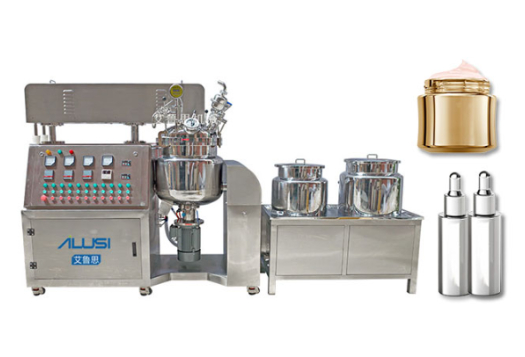
A vacuum emulsifying mixer typically includes:
Key performance considerations:
| Feature | Why It Matters |
|---|---|
| Rotor-stator speed (e.g., 0–3000 rpm or higher) | Determines droplet/particle fineness |
| Shear force | Influences emulsion smoothness and stability |
| Dual-direction stirring | Improves powder dispersion and reduces mixing time |
| CIP/SIP cleaning options | Required for pharmaceuticals and GMP environments |
If your formulation contains powders that form lumps, ensure the system provides strong powder wetting and rapid dispersion.
Look for stainless steel materials such as:
Pay attention to:
For pharmaceutical and medical applications, validation and documentation are essential.
Vacuum emulsifying mixers are available as:
| Control Level | Best For |
|---|---|
| Manual (button switches) | Small labs or low budget |
| Semi-automatic | Small to medium factories |
| PLC fully automatic with touchscreen | High-volume or multi-product production |
Advanced control systems may include:
✔ Programmable recipe storage
✔ Automatic heating/cooling control
✔ Vacuum level monitoring
✔ Speed/torque control
✔ Batch data recording for traceability
Depending on your production goals, you may benefit from:
For example, cosmetics manufacturers often add perfume addition under vacuum to reduce fragrance loss.
Even the best mixer cannot perform well without strong technical support.
When evaluating suppliers, consider:
✔ Experience in your industry
✔ Ability to customize equipment
✔ Availability of spare parts and after-sales service
✔ Training for operators
✔ Long-term service and remote support
Request:
❌ Choosing capacity too large when still developing formulations
❌ Buying low-cost mixers with weak homogenizers
❌ Overlooking cleaning and sanitary design
❌ Ignoring vacuum pump quality and noise level
❌ Not considering long-term expansion or new product lines
| Decision Point | Your Answer |
|---|---|
| Product viscosity | Low / medium / high |
| Batch volume | ___ Liters |
| Required droplet size | Standard / Fine / Ultra-fine |
| Material grade needed | SUS304 / SUS316L |
| Control system | Manual / Semi-auto / PLC |
| Cleanability | Manual / CIP / SIP |
| Budget range | ___ USD |
Choosing the right vacuum emulsifying mixer is not just a procurement decision—it is an investment in product quality, production efficiency, and brand reputation. With the right machine, manufacturers can achieve:
✨ Smoother and more stable emulsions
✨ Reduced production time and labor
✨ Higher ingredient performance
✨ Consistent batch-to-batch results
✨ Lower waste and improved profitability
Whether you are producing high-end cosmetics, pharmaceutical creams, or premium food emulsions, selecting a well-engineered vacuum emulsifying mixer sets the foundation for successful and scalable production. if any confused here, contact with Ailusi Mixer’s experts to deal with your problems !

Contact Us