
Products
In today’s demanding industrial landscape, achieving perfect, stable emulsions is critical for product quality across countless sectors. An emulsifying mixer machine is not just another piece of industrial equipment; it is the engineering cornerstone for creating uniform, shelf-stable mixtures of immiscible liquids like oil and water. From the luxurious texture of your favorite moisturizer to the consistent flavor of a premium salad dressing, these powerful machines work behind the scenes to ensure perfection. This comprehensive guide delves deep into the technology, applications, and selection criteria for emulsifying mixers, providing actionable insights for engineers, production managers, and procurement specialists aiming to optimize their processes.
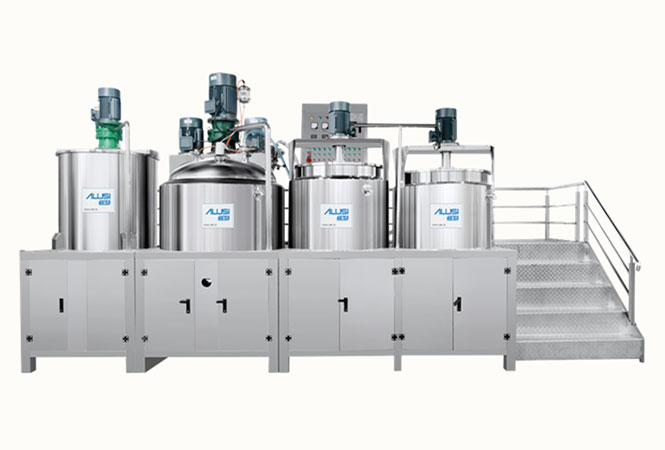
An emulsifying mixer, often termed a high-shear mixer or homogenizer, is a precision-engineered device designed to reduce droplet size within a mixture to microscopic levels. This process, known as emulsification, creates a stable, homogeneous product where one liquid is dispersed evenly throughout another. The crucial role of this machine lies in its ability to directly influence product quality, stability, texture, and appearance. Without proper emulsification, products separate, have inconsistent quality, and suffer from drastically reduced shelf life. In industries like pharmaceuticals, a failed emulsion can mean the difference between a life-saving medication and an ineffective suspension. The machine achieves this through a combination of intense mechanical shear, turbulence, and cavitation forces, making it indispensable for any process requiring a fine, stable dispersion.
The magic of an emulsifying mixer happens through the application of controlled, intense energy. At its heart is a precision rotor-stator assembly or a similar shear-generating mechanism. As the rotor spins at high speeds (often thousands of RPM), it draws materials into the work head. The subsequent hydraulic shear occurs when the fluid is forced at high velocity through the micron-clearance between the rotor and stator. This action tears apart droplets, breaking them down to the target size. Additionally, cavitation and turbulent flow further contribute to particle size reduction. The ultimate goal is to achieve a droplet size so small that Brownian motion prevents coalescence and separation, resulting in a kinetically stable emulsion. Understanding these principles is key to selecting the right machine for specific viscosity, phase volume, and final product requirements.
The market offers a variety of emulsifying mixers, each suited to different scales, viscosities, and process sensitivities. Choosing the wrong type can lead to inefficiency, poor product quality, and increased costs.
In-line (or inline) high-shear mixers are designed for continuous processing pipelines. They are installed directly into a process line, where the product passes through the mixing head and is emulsified in a single, continuous stream. This design is ideal for large-volume production of products like sauces, beverages, or liquid soaps. Key advantages include:
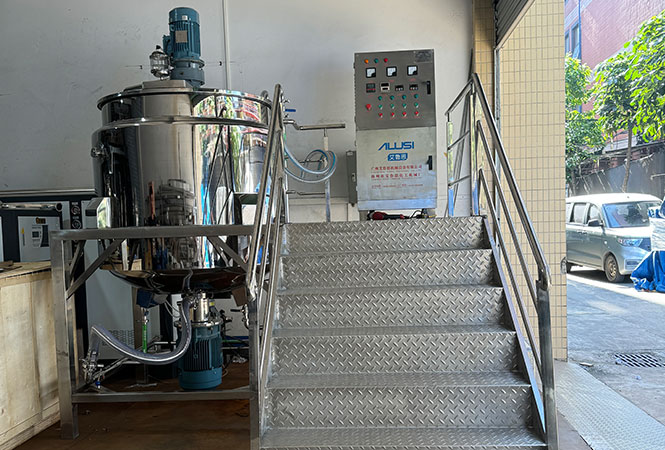
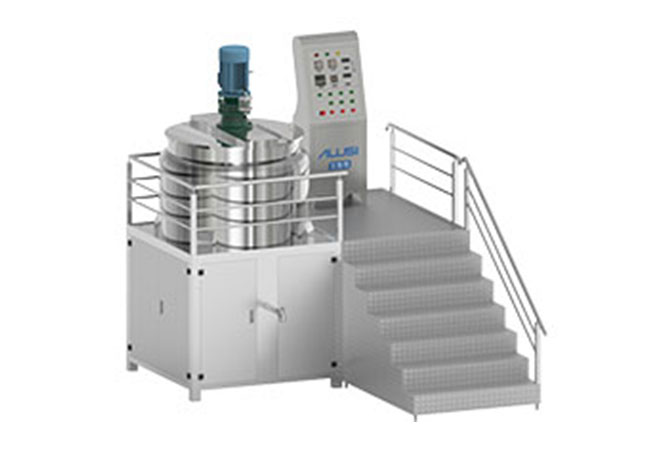
Batch emulsifying mixers are the workhorses of industries that produce products in discrete lots, such as cosmetics, pharmaceuticals, and specialty chemicals. These units feature a mixing shaft that is lowered into a vessel. They offer unparalleled process control, allowing operators to manage temperature, addition order, and mixing time with precision.
For applications requiring the finest possible droplet sizes—often in the nanometer range—ultaviolet emulsification technology is a powerful alternative. Ultrasonic homogenizers use high-frequency sound waves to create intense waves of pressure in a liquid. This leads to the formation and violent collapse of microscopic bubbles (acoustic cavitation), generating localized spots of extreme energy that rip apart droplets. This method is exceptionally effective for:
The emulsifying mixer is a cross-industry pillar, enabling innovation and quality in diverse fields.
In cosmetics, texture is everything. An emulsifying mixer is vital for producing stable, luxurious emulsions like creams, lotions, serums, and conditioners. It ensures that active ingredients, oils, and water are perfectly blended, providing the desired sensorial feel, absorption rate, and long-term stability. A poorly emulsified cream can separate, become grainy, or deliver actives unevenly, leading to customer dissatisfaction and product returns. Modern cosmetic labs rely on versatile batch mixers that can handle everything from thin milks to thick, anhydrous pastes.
From mayonnaise and ketchup to infant formula and protein drinks, emulsification defines product quality. Emulsifying mixers in the food industry must meet stringent hygienic design standards (like 3-A, EHEDG). They are crucial for:
This is where precision is non-negotiable. Pharmaceutical emulsifying mixers are used to create syrups, topical ointments, vaccine adjuvants, and intravenous lipid emulsions. They must be manufactured with cGMP-compliant materials, allow for full validation (IQ/OQ/PQ), and be easy to clean and sterilize (CIP/SIP). The consistency of an emulsion can directly impact the bioavailability of a drug. In the chemical industry, these mixers are used for creating polymer emulsions, adhesives, coatings, and advanced composites, where particle size directly affects performance properties like adhesion strength or film clarity.
Selecting the ideal machine requires a careful analysis of your process and product goals.
Start by defining your process parameters:
Once process needs are clear, evaluate the machine specs:
An emulsifying mixer machine is far more than a simple blender; it is a critical process investment that dictates the fundamental quality, stability, and performance of your final product. Whether you are crafting a new cosmetic line, optimizing a food recipe, or developing a novel pharmaceutical delivery system, the right emulsification technology is paramount. By understanding the core principles, different machine types, and precise application requirements outlined in this guide, you are equipped to make an informed decision. Partner with reputable manufacturers who offer trial testing and strong technical support. Remember, achieving the perfect emulsion is a science—and the right machine is your most vital laboratory instrument. Investing in a high-quality emulsifying mixer today paves the way for superior, consistent, and market-leading products tomorrow.

Contact Us