
Products
In today’s highly competitive manufacturing landscape, companies must consistently improve production efficiency, product quality, and cost-effectiveness. Industries such as cosmetics, pharmaceuticals, food, and chemical manufacturing rely on advanced mixing technology to achieve stable emulsions, uniform dispersions, and consistent texture. Among the most reliable technologies on the market, the vacuum emulsifying mixer has become an essential piece of equipment in modern production lines.
Vacuum emulsifying mixers are widely used for producing creams, lotions, ointments, toothpaste, gels, sauces, emulsified dressings, and various industrial pastes. Manufacturers around the world choose this type of mixer because it integrates multiple functions—making the entire process faster, cleaner, and more efficient.
Companies such as Ailusi Mixer, a manufacturer with years of engineering experience and turnkey production line capability, have refined this technology to serve multiple industries, offering systems that combine mixing, homogenizing, heating, cooling, and vacuum deaeration in one unit. So, how exactly does a vacuum emulsifying mixer improve manufacturing efficiency?
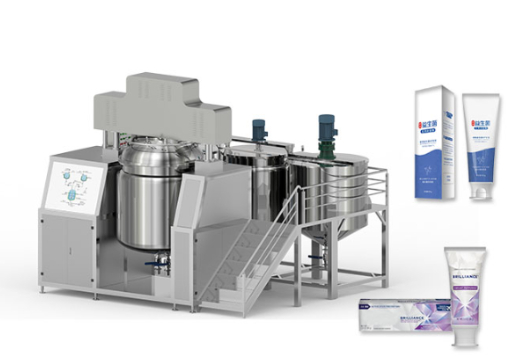
Traditional production often requires separate tanks and machines for heating, mixing, homogenizing, cooling, and removing air bubbles. This leads to:
A vacuum emulsifying mixer combines these operations into a single system, allowing the entire batch to stay in one closed environment from start to finish. This dramatically reduces production time and labor cost while improving overall throughput.
Ailusi’s systems are specifically designed to streamline production by allowing:
One of the primary advantages of vacuum mixing is the removal of air during the emulsification process. Air trapped inside creams, gels, or sauces can cause:
By processing materials under vacuum, the mixer produces smooth, dense, and glossy emulsions that remain stable for a long period of time. This is especially critical for skincare formulations containing active ingredients or pharmaceutical ointments where oxidation must be minimized.
Vacuum emulsifying mixers are equipped with high-shear homogenizer systems that break down particles and combine oil and water phases into extremely fine droplets. This ensures:
Ailusi Mixer’s homogenizing systems are engineered to achieve highly stable emulsions and dispersions, reducing the need for additional stabilizers and enhancing the overall product performance.
Modern production requires strict compliance with hygiene and safety standards. Ailusi’s vacuum emulsifying mixers are built using:
These sanitary design features:
Many vacuum emulsifying mixers are available with advanced control systems such as:
Automation helps manufacturers:
Because of its wide adaptability, a vacuum emulsifying mixer is suitable for various sectors, including:
| Industry | Sample Applications |
|---|---|
| Cosmetics & Personal Care | Creams, lotions, serums, balms, shampoo, toothpaste |
| Pharmaceuticals | Ointments, gels, topical medicines |
| Food & Beverage | Sauces, mayonnaise, salad dressings, spreads |
| Chemical & Industrial | Coatings, adhesives, lubricants, wax emulsions |
This versatility makes the vacuum emulsifying mixer a valuable long-term investment for manufacturers planning product line expansion.
Although advanced mixing equipment represents an initial investment, the long-term returns are substantial due to:
For companies scaling production, a vacuum emulsifying mixer becomes significantly more cost-effective compared to traditional mixing equipment.
Vacuum emulsifying mixers are transforming manufacturing operations by increasing speed, consistency, and product quality while lowering operating costs. With integrated process functionality, high-shear homogenization, vacuum deaeration, hygienic construction, and intelligent controls, this technology has become essential for competitive production environments.
Manufacturers who adopt equipment engineered by companies like Ailusi Mixer gain access to reliable, efficient mixing systems designed for cosmetics, pharmaceutical, food, and chemical industries—enhancing both efficiency and market competitiveness.

Contact Us