
Products
As a core piece of equipment in sectors such as fine chemicals, food and pharmaceuticals, and cosmetics, the technological sophistication of emulsifiers directly impacts product quality and production efficiency. This article delves deeply into the technical principles, equipment types, and key selection points of emulsifiers, providing a comprehensive and professional reference for industry practitioners.
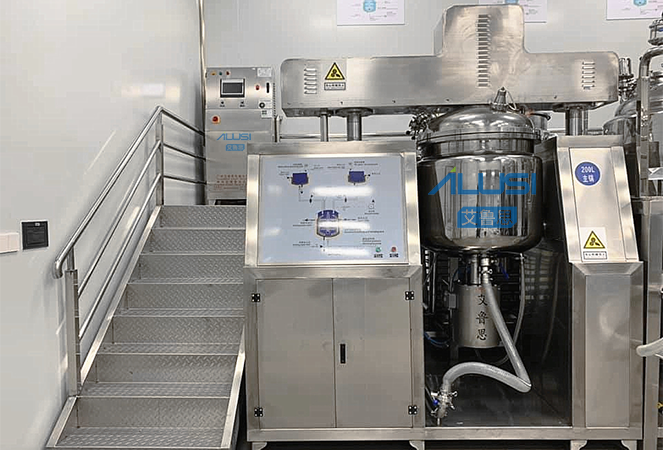
The emulsification process is fundamentally about applying mechanical energy to disperse one or more immiscible liquids (most commonly oil and water) into one another, forming one phase into tiny droplets dispersed within the other phase, resulting in a relatively stable dispersion system. This process involves complex physical changes such as overcoming interfacial tension, droplet fragmentation, and redistribution.
Key indicators for successful emulsification include particle size distribution, emulsion stability, and system homogeneity. High-quality emulsification equipment can achieve sub-micron level dispersion results in a short time and ensure product stability throughout its shelf life.
As various industries demand higher product quality, modern emulsifiers must meet the following core requirements: high-efficiency processing capability, precise process control, ease of cleaning and maintenance, compliance with industry hygiene standards, and stable long-term operational performance. Advanced emulsification equipment now incorporates intelligent control systems, enabling digital parameter recording and process traceability.
The core of a high-shear emulsifier lies in its precision stator-rotor structure. The rotor generates powerful centrifugal force during high-speed rotation, pushing material from the center of the working chamber towards the periphery. Meanwhile, the stator shears, impacts, and tears the material through precisely designed pores or gaps. This structure creates a local energy density reaching up to 10³-10⁴ kW/m³, sufficient to overcome the interfacial tension of most systems.
The stator-rotor gap is typically controlled between 0.2-0.5mm. This minute gap determines the final shear intensity and emulsification fineness. Gap adjustment technology has become a hallmark feature of high-end emulsifiers, allowing the same equipment to handle products with different viscosities and emulsification requirements.
Modern high-efficiency emulsifiers typically integrate multiple shear mechanisms: first, primary shear generated by direct rotor rotation; followed by pore shear as material passes through stator pores; and finally turbulent shear formed between the chamber wall and rotor. The synergistic action of these three shear mechanisms makes the emulsification process more thorough and the particle size distribution more concentrated.
Some advanced models also incorporate bidirectional shear technology, generating both radial and axial shear flows simultaneously through specially designed rotor blades, further reducing emulsification time and improving efficiency by over 30%.
Performing emulsification operations under vacuum conditions effectively prevents air bubbles from mixing into the product system. Bubbles not only affect emulsion uniformity but can also become catalysts for product oxidation and spoilage. Vacuum emulsification systems typically control pressure between -0.095 to -0.098 MPa. In this environment, the boiling point of materials decreases and the water evaporation temperature drops, which is beneficial for processing heat-sensitive components.
The vacuum environment also promotes the escape of trace gases from the material. These gases might exist as micro-bubbles within the interfacial film under atmospheric pressure, weakening the long-term stability of the emulsion system. Experimental data show that the shelf life of vacuum-emulsified products is typically 25-40% longer than products made under atmospheric pressure.
Advanced vacuum emulsification systems integrate multifunctional modules for deaeration-homogenization-cooling. During initial emulsification, the vacuum system rapidly removes gases entrained in the material. Throughout the emulsification process, a negative pressure environment is continuously maintained to prevent new bubble formation. After emulsification, the system can directly cool the product under vacuum, avoiding potential oxidation issues when hot products come into contact with air.
This integrated design is particularly suitable for fields with zero tolerance for bubbles, such as high-end cosmetics, pharmaceutical emulsions, and precision electronic chemicals.
Batch emulsifiers are currently the most widely used type. Their typical structure includes a main emulsification tank, a premix system, and a temperature control system. Single-batch processing capacities range from laboratory-scale 0.5L to industrial-scale 5000L.
The primary advantage of this equipment is high process flexibility, making it especially suitable for small-batch, multi-variety production modes. Operators can adjust emulsification time, temperature, and rotational speed parameters in real-time based on the characteristics of each batch. However, its significant limitations include the risk of quality fluctuations between batches and relatively lower output per unit time.
Batch emulsifiers dominate in the production of cosmetic creams, pharmaceutical ointments, and specialty chemicals, where there is a high demand for frequent formula adjustments.
Continuous emulsification systems achieve continuous material feeding, emulsification, and discharging through precision in-line mixers and pipeline-type emulsification units. Core equipment typically includes high-precision metering pumps, static mixers, and in-line homogenizer units.
The greatest advantage of this system is its extremely high production efficiency, making it suitable for large-scale production of single product types. Modern continuous systems are equipped with in-line particle size monitors and automatic feedback adjustment devices, allowing real-time adjustment of process parameters to ensure product consistency.
Continuous emulsification systems excel in large-scale continuous production fields such as dairy products, liquid detergents, and emulsion polymers. The latest continuous systems have increased single-line capacity to over 10 tons per hour while maintaining a coefficient of variation for particle size distribution of less than 5%.
The pharmaceutical industry imposes extremely strict requirements on emulsification equipment, which must comply with relevant regulations such as cGMP and FDA. Core features of pharmaceutical-grade emulsifiers include: full 316L stainless steel construction, mirror polishing (Ra ≤ 0.4μm), dead-space-free design, complete CIP/SIP (Clean-in-Place/Sterilize-in-Place) systems, and data recording and tracking capabilities.
In recent years, single-use emulsification systems have rapidly developed in the biopharmaceutical field. These systems use pre-sterilized single-use emulsification bags instead of traditional stainless steel tanks, completely eliminating the risk of cross-contamination. They are particularly suitable for preparing high-value biologics like cell culture media and vaccine adjuvants.
While ensuring food safety, food emulsification equipment is evolving towards high efficiency, energy savings, and flavor preservation. Vacuum low-temperature emulsification technology is widely used in high-end condiments and dairy alternatives, controlling emulsification temperatures below 40°C to maximally preserve heat-sensitive flavor compounds.
Advancements in intelligent cleaning systems have significantly improved the hygiene standards of food emulsification equipment. The latest sensor technology can monitor cleaning solution concentration, temperature, and flow rate in real-time, ensuring cleaning effectiveness meets food safety standards while reducing water consumption and chemical cleaning agent usage by over 30%.
Emulsifier selection cannot be based simply on “power” or “capacity”; it requires a systematic process compatibility assessment. Key evaluation indicators include: the target product’s viscosity range (centipoise), desired particle size (D90 value), material heat sensitivity, production batch scale, and potential for future formula expansion.
Experienced engineers recommend a step-by-step scale-up principle: lab trial → pilot trial → mass production. Lab trials determine basic process parameters; the pilot trial phase verifies the rationality of equipment selection; final production equipment specifications are determined based on pilot trial data. This scientific selection path can reduce equipment investment risk by over 60%.
Emulsification is a typical high-energy-consumption process, making energy efficiency a crucial factor in equipment selection. Specific energy consumption (energy consumption per unit product) is a core evaluation metric. Advanced emulsifiers can reduce specific energy consumption by 25-35% compared to traditional equipment.
Beyond motor power, attention must also be paid to the equipment’s thermal management capabilities. Efficient heat exchange systems can quickly transfer mechanical heat generated during emulsification, reducing the need for external cooling. Some innovative designs use a combination of jacketed and internal coil cooling, improving cooling efficiency by over 40%.
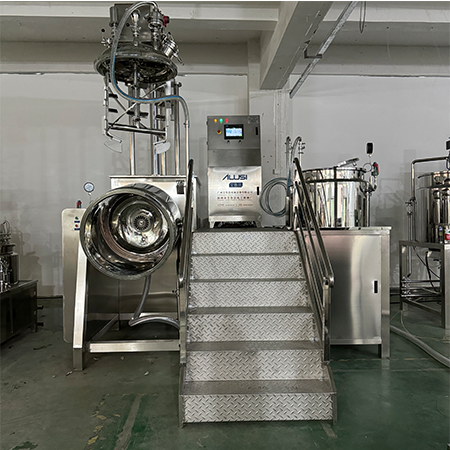
Standardized operating procedures are the foundation for ensuring stable emulsification quality. Standard Operating Procedures (SOPs) should clearly define the following critical control points: material addition sequence and speed (especially the ratio and timing of aqueous and oil phase addition), emulsification temperature control curve, vacuum establishment steps, rotational speed adjustment procedures, and sampling/testing timing.
Practical experience shows that a multi-stage rotational speed control strategy often yields better emulsification results: initial low speed for preliminary mixing, maximum speed for thorough shearing, and appropriately reduced speed for final fine-tuning. Compared to full-process high-speed emulsification, this strategy can save 15-20% in energy consumption while achieving a narrower particle size distribution.
The high-shear working characteristics of emulsifiers make wear inevitable. A preventive maintenance plan should include: regular inspection and adjustment of the stator-rotor gap (recommended every 500 operating hours), monitoring mechanical seal lifespan, regular assessment of bearing lubrication status, and vibration analysis of all moving parts.
Advanced equipment management systems now integrate predictive maintenance functions. By monitoring current fluctuations, temperature changes, and vibration spectra, potential faults can be identified early. This intelligent maintenance strategy can reduce unexpected downtime by 70%, lower spare parts inventory costs by 30%, and improve overall equipment effectiveness by over 25%.
Modern emulsifiers are rapidly evolving towards intelligence. The application of Internet of Things (IoT) technology allows equipment to upload operational data to cloud platforms in real-time, enabling operators to remotely monitor production status via mobile terminals. Artificial intelligence algorithms are beginning to be applied to process optimization. Systems can automatically recommend optimal process parameter combinations based on historical data, shortening the trial production cycle for new products by over 50%.
Digital twin technology is revolutionizing emulsification process development. Creating digital models of equipment and materials in a virtual environment can simulate emulsification effects under different parameters, significantly reducing the number of physical trials. This is particularly valuable for product development involving high-cost raw materials.
Increasingly stringent environmental regulations are driving emulsification equipment towards green manufacturing. The integration of energy-saving technologies has become a focus of equipment competition: high-efficiency permanent magnet motors can save 20-30% more energy than traditional induction motors; heat recovery systems can convert heat generated during emulsification into preheating energy, reducing overall energy consumption.
Material innovation is also propelling industry progress. New wear-resistant coating technologies extend stator-rotor lifespan by 2-3 times. Equipment designed with ecological principles in mind features higher modularity, making key components easier to replace and recycle, reducing the environmental footprint over the equipment’s entire lifecycle by over 35%.
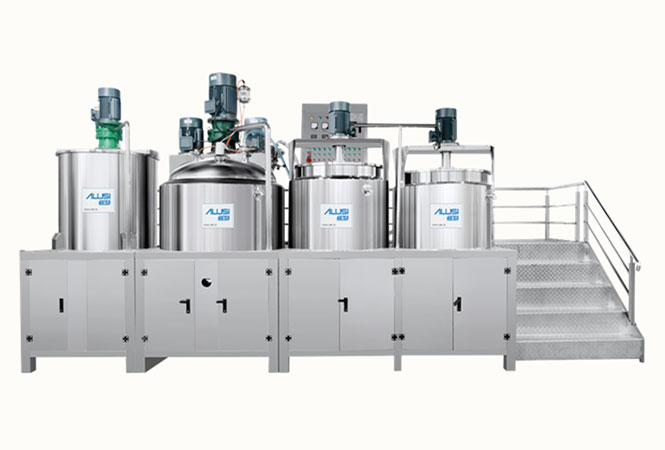
Selecting and applying emulsifiers is a comprehensive technology combining mechanical engineering, fluid mechanics, and materials science. Successful emulsification processes rely not only on advanced equipment hardware but also on operators’ deep understanding of emulsification mechanisms and rich practical experience.
As product refinement continues to increase across industries, the requirements for emulsification technology will keep rising. Future successful manufacturers will be those who perfectly combine advanced equipment with sophisticated processes, finding the optimal balance between efficiency and quality, innovation and tradition. A deep understanding of the technological core of emulsifiers is the crucial first step towards this goal.

Contact Us