Home • Vacuum Emulsifying Machine: In-Depth Analysis of Core Technology and Industry Applications
Vacuum Emulsifying Machine: In-Depth Analysis of Core Technology and Industry Applications
Ailusi
2026-02-04
70
Introduction: The Revolutionary Equipment Redefining Mixing Technology
In modern fine chemical, pharmaceutical, cosmetic, and food industries, the vacuum emulsifying machine has become an indispensable core piece of equipment. Behind this seemingly complex machine lies revolutionary technology that has transformed production methods across multiple sectors. Unlike traditional mixing equipment, the vacuum emulsifying machine achieves a qualitative leap in material mixing through its unique combination of a vacuum environment and high shear force—resulting not only in more homogeneous mixing but also in the avoidance of issues like air bubbles, oxidation, and contamination, directly enhancing product quality and stability.
As consumer demands for product quality increase and manufacturing pursues greater efficiency, energy savings, and consistency, vacuum emulsification technology is transitioning from an “optional equipment” to a “necessary weapon.” This article provides a comprehensive analysis of this technology’s core principles, industry applications, and key selection criteria, offering valuable insights for your production decisions.
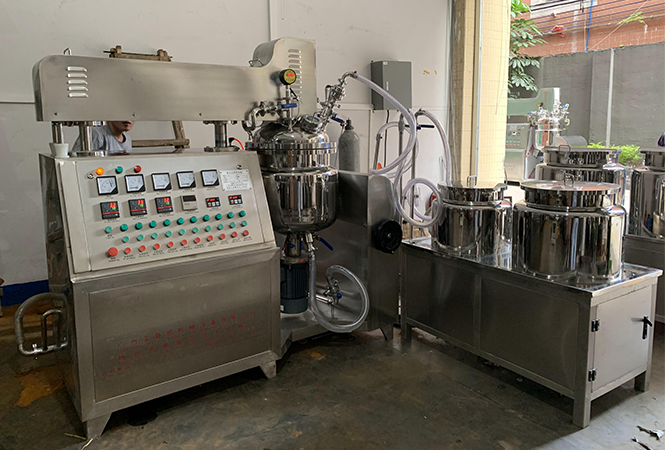
Cosmetic Homogenizer Emulsifier
Part 1: Decoding the Core Technology of Vacuum Emulsifying Machines: More Than Just “Mixing”
1.1 The Vacuum System: The Invisible Critical Advantage
The vacuum system is the soul of this equipment. Its role extends far beyond the superficial understanding of “removing air.” Operating under a vacuum environment fundamentally transforms the material mixing process:
Complete Elimination of Air Bubbles: In traditional mixing, air entrained in materials forms micro-bubbles, affecting product appearance, stability, and subsequent processes. In a vacuum environment (typically reaching -0.095 MPa or lower), these bubbles are completely eliminated. This is crucial for products demanding perfection, such as creams, ointments, and high-end coatings.
Prevention of Oxidative Deterioration: Many active ingredients (like Vitamin C, peptides, plant extracts) are highly sensitive to oxygen. The vacuum environment effectively isolates oxygen, protecting these valuable components from deactivation during processing and extending the final product’s shelf life.
Lower Boiling Points, Energy Efficiency: Under vacuum, the boiling point of water significantly decreases. Materials can have moisture or volatiles removed at lower temperatures, greatly saving energy while preventing thermal degradation of heat-sensitive components.
1.2 The Homogenization & Emulsification System: The Art of Controlling the Microscopic World
The homogenization/emulsification head is the “heart” of the equipment. Its design directly determines the fineness and stability of the final product:
Three-Stage Emulsification Mechanism: High-quality vacuum emulsifiers employ a multi-stage emulsification structure. Stage 1: A high-speed rotor generates powerful suction to draw materials into the shear zone. Stage 2: Within the minute gap between rotor and stator (as small as 0.2-0.3mm), materials undergo intense shear forces at speeds of 10,000-30,000 RPM, tearing particles down to the micron level. Stage 3: Through specially designed stator openings, material is ejected at high velocity, completing the final refinement.
Shear Rate and Particle Size Control: By precisely controlling rotor tip speed (up to 40 m/s) and stator geometry, droplet or particle size can be controlled within 1-5 microns or even the nanoscale. This microscopic uniformity, unachievable with traditional mixing, directly determines emulsion stability. Smaller particle size means slower creaming/sedimentation rates and longer shelf life.
Precise Temperature Control: The emulsification process generates heat. Advanced equipment integrates precise temperature control systems (typically using jacketed circulation and PID control), ensuring materials remain within the optimal temperature range throughout the process, balancing efficiency and ingredient protection.
Part 2: Why Top Companies Choose Vacuum Emulsifying Machines: Four Irreplaceable Advantages
2.1 Quality Enhancement: The Leap from “Qualified” to “Excellent”
In competitive markets, subtle quality differences can determine brand positioning:
A Stability Revolution: Emulsions produced by traditional methods have a wide particle size distribution, prone to separation and “weeping” during storage. Products from vacuum emulsifiers have a concentrated particle size distribution and superior zeta potential, theoretically extending shelf life by 50%-200%. A well-known cosmetic brand reported its accelerated stability test for a flagship cream improved from 3 to 8 months with no changes after adopting this technology.
Breakthroughs in Texture & Sensory Properties: A more uniform microstructure directly enhances user experience—ointments absorb more easily, cosmetics feel finer and smoother, food sauces have a more consistent mouthfeel. This “premium feel” is key to consumer willingness to pay a premium.
Efficient Active Ingredient Delivery: In pharmaceuticals and efficacious cosmetics, the transdermal absorption rate of active ingredients is directly related to particle size. Nano-scale emulsification can significantly increase bioavailability, allowing the same formulation to perform more effectively.
2.2 The Hidden Winner in Production Efficiency & Cost Control
The seemingly high initial investment often shows remarkable returns over the full production lifecycle:
Batch Time Reduction of 30%-50%: Material viscosity decreases under vacuum, drastically improving mixing efficiency. Integrated design (combining heating, cooling, homogenization, discharge) minimizes material transfer, consolidating multiple traditional steps into a single process.
Raw Material Savings Up to 15%: More efficient emulsification allows for reduced emulsifier usage without compromising stability. The vacuum environment minimizes volatilization loss. Precise temperature control prevents thermal degradation waste. A medium-sized pharmaceutical company reported annual raw material savings exceeding $110,000.
Reduced Labor & QC Costs: Automated control systems enable digital, repeatable parameters, reducing reliance on operator experience. Batch-to-batch variation is significantly minimized, allowing for potential reduction in QC sampling frequency.
2.3 Safety & Cleanliness: Modern Production Standards
Closed Production, Zero Cross-Contamination: The fully enclosed system complies with stringent standards like GMP and ISO22716, preventing external contamination and protecting operators from exposure to hazardous substances—especially critical for active ingredients and hormonal drug production.
Integrated CIP (Clean-in-Place) Systems: Advanced models feature automated cleaning functions. Cleaning agents circulate within the system, achieving 70% higher cleaning efficiency than manual methods, reducing water usage by 60%, and allowing for validation of cleaning results to meet strict pharmaceutical requirements.
Data Integrity Assurance: Process parameters (vacuum level, temperature, speed, time) are automatically recorded, complying with data integrity regulations like FDA 21 CFR Part 11, providing reliable data for audits and process optimization.
Part 3: In-Depth Analysis of Industry Applications: Customized Solutions for Different Fields
3.1 Cosmetics & Personal Care: The Scientific Instrument of Beauty
Anti-Aging Products: Nano-emulsification technology encapsulates active ingredients like retinol and peptides in microcapsules, enhancing stability and enabling controlled release, improving efficacy by over 30%.
Sunscreen Products: The homogeneous dispersion of physical sunscreens like titanium dioxide and zinc oxide directly determines SPF accuracy and cosmetic elegance (avoiding white cast). Vacuum homogenization ensures complete dispersion, balancing high SPF with a natural finish.
Innovative Formulation Breakthroughs: Complex emulsions (e.g., Water-in-Oil-in-Water), lamellar gel structures, and cold-process formulations require precise temperature control and high-shear homogenization for stable mass production.
3.2 Pharmaceuticals & Biotechnology: Ensuring Efficacy and Safety
Topical Formulation Homogeneity: For semi-solid dosage forms like creams, gels, and sprays, the uniformity of drug distribution directly impacts therapeutic consistency. The vacuum environment prevents microbial contamination, meeting aseptic production requirements.
Solubility Enhancement for Poorly Soluble Drugs: Nano-emulsification technology can reduce the particle size of poorly water-soluble drugs (e.g., some anticancer agents) to the nanoscale, dramatically increasing bioavailability—a key pathway in innovative formulation development.
Modernization of Herbal Extraction: Conducting extraction and preliminary emulsification under vacuum reduces damage to heat-sensitive compounds and increases extraction yields of active ingredients, advancing traditional medicine towards standardized, quantifiable production.
3.3 Food Industry: From Taste to Functional Upgrades
High-End Sauces & Condiments: The stability and mouthfeel of salad dressings, mayonnaise, and hot pot bases are directly determined by emulsion quality. Vacuum technology prevents oxidative rancidity, extending shelf life.
Functional Beverages: Uniformly dispersing nutrients like vitamins, Omega-3, and plant sterols in aqueous bases prevents settling and separation. Vacuum de-aeration prior to filling further aids preservation.
Alternative Proteins & Meat Analogs: The fibrous texture and mouthfeel of emerging plant-based protein products depend heavily on the emulsification and structuring of proteins, making vacuum homogenizers a critical processing node.
Part 4: How to Choose the Right Vacuum Emulsifying Machine: A Professional Selection Guide
4.1 Define Your Needs: Avoid “Over-Engineering” and “Under-Specification”
Analyze Material Characteristics: Viscosity range (need for variable speed?), thermal sensitivity (required temperature control precision), corrosiveness (material selection), solid content (need for special agitator design?) dictate basic equipment parameters.
Plan for Volume & Batching: Different scales—Lab (1-50L), Pilot (50-500L), Production (500-3000L)—serve different needs. Consider future growth and allow for reasonable capacity headroom.
Identify Special Process Requirements: Determine if in-line addition, in-line particle size analysis, automatic cleaning, automatic lifting, or explosion-proof design are needed. Each feature adds cost but may significantly boost efficiency or ensure regulatory compliance.
4.2 In-Depth Evaluation of Core Components: Details Determine Success
Homogenizer Head Design: Different stator-rotor geometries (teeth, holes, screens) suit different materials. Inquire about specific shear rate data, not just motor power. High-quality equipment offers interchangeable homogenizer modules for versatility.
Reliability of the Sealing System: Mechanical seal or magnetic drive? The former requires slightly more maintenance but handles higher torque; the latter offers complete leak-free operation at a higher cost. Understand seal brand, replacement cycles—downtime is also a cost.
Intelligence of the Control System: PLC touchscreen control is standard. Evaluate features like recipe storage, user access management, data export, and remote monitoring capabilities. These “soft capabilities” impact long-term production management efficiency.
4.3 Supplier Selection: You’re Buying a Service, Not Just a Machine
Technical Validation Support: Reputable suppliers offer lab trial services using your actual materials to demonstrate results and provide process parameter recommendations. This is the best way to avoid specification errors.
Completeness of Compliance Documentation: Request material certificates, electrical safety certifications, pressure vessel documentation (if applicable), and software validation protocols (IQ/OQ/PQ templates). These are crucial for pharmaceutical and cosmetic certifications.
After-Sales Service Network: Investigate the supplier’s response time, spare parts inventory, and technical team qualifications. Inquire about preventive maintenance plans—hourly losses from downtime can far exceed service costs.
Part 5: Future Trends and Innovation Directions in Vacuum Emulsification Technology
5.1 Deep Integration of Intelligence and Digitalization
AI-Powered Process Optimization: Using sensor data (temperature, viscosity, power draw), AI algorithms automatically adjust parameters to achieve target particle size distributions and learn optimal process paths for different materials.
Predictive Maintenance: Monitoring bearing vibration, seal wear, motor efficiency, etc., enables early fault warnings, potentially reducing unplanned downtime by over 80%, enabling truly worry-free production.
Blockchain for Quality Traceability: Encrypted process parameters uploaded to a blockchain allow end consumers to scan and verify the entire production history, providing an immutable quality certificate for premium brands.
5.2 Green Manufacturing and Sustainable Development
Further Energy Reduction: Next-generation high-efficiency motors, variable frequency drives, and heat recovery systems could reduce energy consumption per unit output by an additional 25%. The EU is beginning to set energy efficiency standards for production equipment.
Modular & Upgradeable Design: Equipment core frames are designed for a 20+ year lifespan, while control systems and homogenizer modules can be upgraded as technology advances, avoiding complete obsolescence and reducing waste.
Cleaning Technology Breakthroughs: Novel surface coatings create smoother, more corrosion-resistant internal surfaces, reducing cleaning agent use. Ultrasonic-assisted cleaning further cuts water consumption and wastewater treatment burden.
5.3 Multifunctional Integration and Flexible Production
All-in-One Multifunctionality: Integrating homogenization, dispersion, heating, cooling, de-aeration, and drying into a single unit is ideal for R&D centers and small-batch, multi-product manufacturing.
Modular Production Lines: The vacuum emulsifier serves as the core module, seamlessly connecting with automatic dosing systems, in-line analyzers, and filling lines to form continuous or semi-continuous production lines, adapting to the trend of personalized, on-demand manufacturing.
Conclusion: Embrace Technological Transformation to Build Core Product Competitiveness
The vacuum emulsifying machine has evolved from a simple “production tool” into a technology platform for product innovation. For companies pursuing excellence, it is not merely a means to improve efficiency but a core technological enabler for pushing formulation boundaries and creating differentiated products.
Driven by both consumer premiumization and manufacturing transformation, mastering and optimizing this technology early allows companies to build competitive moats in: superior product stability, longer shelf life, better user experience, faster R&D cycles, and more regulatory-compliant production systems.
Investing in a suitable vacuum emulsifying machine is, in essence, an investment in a company’s future competitiveness. We advise decision-makers to think beyond “equipment procurement” and plan from the perspective of “process upgrade” and “capability building.” Partner with suppliers possessing deep technical expertise to make this advanced technology a true amplifier of brand value.
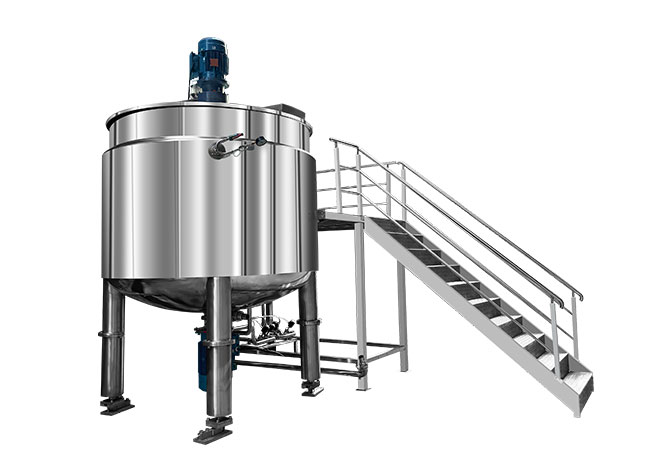
Homogenizer Mixer Emulsifier
Ultimately, in the competition of manufacturing, the companies that first master and effectively leverage core technological equipment will gain the authority to define industry standards in an era where quality reigns supreme.