
Products
The vacuum emulsifying machine represents the pinnacle of modern mixing technology. This highly efficient equipment plays an indispensable role in industries such as pharmaceuticals, cosmetics, food, and chemicals. Compared to traditional mixing equipment, the vacuum emulsifying machine achieves revolutionary breakthroughs in product stability, uniformity, and quality through efficient shearing, dispersion, and emulsification processes conducted within a vacuum environment. This article provides an in-depth exploration of the core technology, industry applications, key selection factors, and future development trends of vacuum emulsifying machines, offering comprehensive and professional insights.

The working principle of a vacuum emulsifying machine is founded at the intersection of precision engineering and physical chemistry. During operation, the equipment first creates a vacuum environment typically between 0.05 and 0.098 MPa. This critical step eliminates interference from air bubbles in the emulsification process and significantly reduces the oxidation rate of materials. Under vacuum, the boiling point of materials is lowered, allowing for deaeration at relatively low temperatures, which is crucial for protecting heat-sensitive ingredients.
The core emulsification unit employs a three-stage mixing structure: First, a high-speed shear head generates intense mechanical action to preliminarily break down large particles. Next, a precise rotor-stator structure creates micron-level shear forces, refining droplets to the target particle size. Finally, a slow-speed stirring system completes the homogenization process. This graded processing mechanism ensures comprehensive coverage from macro-mixing to micro-dispersion.
Modern high-end vacuum emulsifying machines are equipped with intelligent control systems that enable precise coordinated control of temperature, vacuum level, stirring speed, and time parameters. The jacketed design allows for the circulation of thermal oil or cooling water, maintaining materials within a preset temperature range (often with ±2°C accuracy) during emulsification. This feature is vital for protecting active ingredients and ensuring batch-to-batch consistency.
Data logging and traceability systems have become industry-standard configurations, capable of recording all process parameters for each production batch in detail, complying with GMP standards in pharmaceutical and cosmetic industries. Some advanced models are even equipped with online particle size detection systems, allowing for real-time monitoring of emulsification quality and the practical application of Process Analytical Technology (PAT) in emulsification production.
In the pharmaceutical industry, vacuum emulsifying machines are primarily used for producing emulsions, liposomes, microemulsions, and nano-formulations. The oxygen-free environment they create effectively prevents the oxidation and deterioration of drug components, while the controlled temperature range ensures the stability of bioactive ingredients. For injectable emulsions, vacuum emulsifiers can uniformly disperse oil phase particles into the range of 0.2-0.5 microns, fully meeting the strict pharmacopoeial standards for intravenous emulsions.
Modern vaccine adjuvant production also relies on vacuum emulsification technology, particularly for water-in-oil type adjuvants. The precisely controlled shear forces achieved by vacuum emulsifiers enable the production of adjuvants with uniform particle size distribution and stability lasting several years—a breakthrough unattainable with traditional stirring equipment.
The high-end cosmetics industry relies heavily on vacuum emulsifying machines; nearly every bottle of lotion, cream, or serum undergoes vacuum emulsification. In this field, the equipment must not only achieve uniform mixing of raw materials but also protect the integrity of active ingredients (such as Vitamin C, peptides, and plant extracts).
The vacuum environment effectively prevents the premature oxidation of antioxidants in cosmetics while avoiding product texture inconsistencies caused by air bubble incorporation. Advanced vacuum emulsifiers can handle the full spectrum of cosmetic bases—from aqueous to oily, and from low to high viscosity—achieving exceptional stability with no separation for over 24 hours, significantly extending product shelf life.
When selecting a vacuum emulsifying machine, the first step is clarifying production needs. Laboratory R&D models typically have capacities ranging from 1 to 50 liters, while industrial production models can range from 50 to 5000 liters or more. When determining capacity, consider material characteristics, production batch frequency, and future development needs. It is generally advisable to choose a model 20-30% larger than current requirements to accommodate business growth.
Power configuration must match capacity and material properties: High-viscosity materials (e.g., silicone oil-based products) require higher power motors and reinforced mechanical seals, while low-viscosity materials can use standard configurations. Modern efficient designs control the power density (power-to-capacity ratio) within a reasonable range, ensuring emulsification quality while reducing energy consumption.
The material selection for a vacuum emulsifying machine directly impacts product quality and equipment durability. 316L stainless steel has become the standard for pharmaceutical and food industries due to its superior corrosion resistance and cleanability compared to 304 stainless steel. For particularly corrosive materials, Hastelloy or titanium lining may be necessary.
Sanitary design is equally crucial: Equipment interiors should feature full polishing (typically Ra ≤ 0.4μm) and a dead-space-free structure, with all connections using sanitary quick-disconnect clamps. Designs compliant with GMP requirements include tilting kettles, CIP (Clean-in-Place) systems, and SIP (Sterilize-in-Place) capabilities. These features significantly reduce cross-contamination risk and enhance production compliance.
The concept of Industry 4.0 is profoundly transforming the design and operation of vacuum emulsifying machines. Next-generation equipment will integrate more advanced sensor networks to monitor key parameters such as viscosity, particle size distribution, and phase inversion points in real-time, optimizing process parameters through machine learning algorithms. Digital twin technology allows for the simulation and optimization of emulsification processes in a virtual environment, significantly reducing trial-and-error costs in actual production.
Cloud platform connectivity enables equipment manufacturers to remotely monitor machine status, predict maintenance needs, and even perform remote diagnostics and parameter optimization. This shift towards servitization not only improves equipment reliability but also provides users with continuously optimized production process packages.
With growing global emphasis on sustainability, vacuum emulsifier manufacturers are committed to reducing the environmental footprint of their equipment. Innovative designs include high-efficiency motors reducing energy consumption by 30-40%, heat recovery systems utilizing process waste heat to pre-warm raw materials, and more compact designs that reduce stainless steel usage without compromising performance.
The modular design concept allows users to flexibly configure equipment functions based on production needs, avoiding over-investment. Easy-disassembly designs enable up to 90% material recyclability at the end of the equipment’s lifecycle, aligning with circular economy principles.
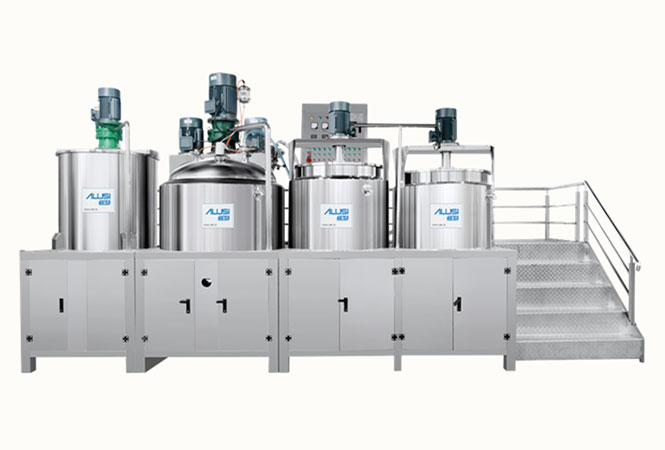
As a core piece of equipment in modern fine chemical processing, the vacuum emulsifying machine continues to expand in both technological depth and breadth of application. From ensuring strict process control for pharmaceutical safety to creating pleasurable cosmetic textures, this technology plays an irreplaceable role across multiple industries. With the deepening trends of intelligentization and sustainability, vacuum emulsification technology will continue to propel related industries toward greater efficiency, precision, and environmental friendliness.
For businesses considering investing in vacuum emulsification equipment, we recommend thoroughly analyzing your specific product characteristics, capacity needs, and compliance requirements. Engage in detailed communication with experienced technical suppliers to select a solution that not only meets current production demands but also offers the flexibility to adapt to future developments. In the field of fine chemicals, the correct choice of emulsification equipment is often a key factor in product success and market differentiation.
What emulsification challenges does your industry face? Feel free to share your specific needs and application scenarios. Let’s explore together how vacuum emulsification technology can bring substantial improvements to your production processes.

Contact Us