
Products
The vacuum homogenizing emulsifier is an indispensable high-end mixing equipment in modern fine chemical, pharmaceutical, food, and cosmetics industries. This innovative technology, by combining a vacuum environment, high-speed shearing, and precise temperature control systems, achieves uniformity and stability unattainable by traditional mixing methods. As global manufacturing pursues higher quality and greater efficiency, vacuum homogenizing emulsification technology is becoming a key technology for enhancing product competitiveness across numerous sectors.
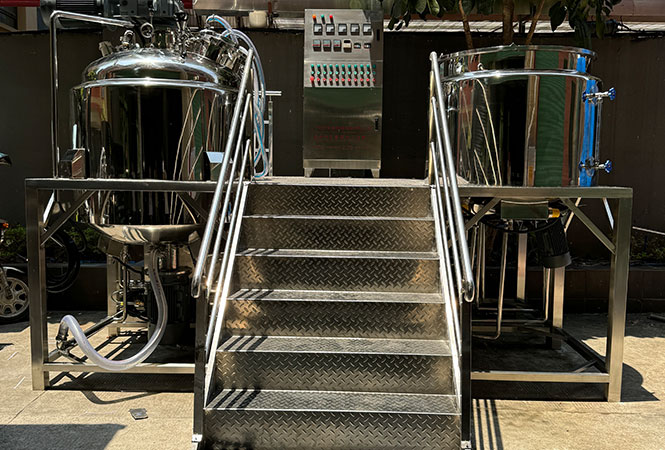
The core characteristic of a vacuum homogenizing emulsifier is processing materials under negative pressure. This design addresses common bubble issues in traditional emulsification processes while significantly improving the stability and sensory quality of the final product.
Operating under vacuum, the equipment can effectively remove air and volatile components entrained during the mixing process. This is particularly important for cosmetic creams, pharmaceutical emulsions, and premium food emulsions, as bubbles in these products not only affect appearance but also accelerate oxidation, reducing shelf life. Experimental data shows that under identical formula and process conditions, vacuum emulsification can reduce product bubble content by over 90% and improve product stability by 40-60% compared to atmospheric emulsification.
The vacuum environment also creates more favorable mixing conditions. Under negative pressure, the surface tension of materials decreases, making the dispersed phase easier to break into fine particles, thereby forming a more uniform and finer emulsion system. This characteristic is especially critical for preparing nanoemulsions, as many high-end skincare products and targeted drug delivery systems rely on this ultra-fine emulsification technology.
Vacuum homogenizing emulsifiers achieve exceptional mixing results through a multi-stage action mechanism:
The High-Speed Shearing System is the core component of the equipment, typically employing a stator-rotor structure. The rotor rotates at speeds of thousands of revolutions per minute, generating intense shear, impact, and turbulence within the stator gaps. This mechanical energy breaks the dispersed phase into micron or even nanometer-sized particles, significantly increasing the interfacial area between phases and facilitating more effective action of emulsifiers.
The Recirculation Homogenization System ensures all materials pass multiple times through the high-shear zone. Unlike batch mixing, vacuum homogenizing emulsifiers typically employ a recirculation processing mode, where materials continuously circulate between the vacuum tank and the homogenizing head. This ensures every portion of material undergoes the same processing intensity and duration, achieving high consistency within a batch.
The Precision Temperature Control System is crucial for the emulsification process. Many emulsification reactions are highly sensitive to temperature, particularly near phase transition points. Modern vacuum homogenizing emulsifiers are equipped with multi-stage temperature control systems capable of precisely regulating temperature changes at different stages, ensuring the emulsification process occurs under optimal thermodynamic conditions.
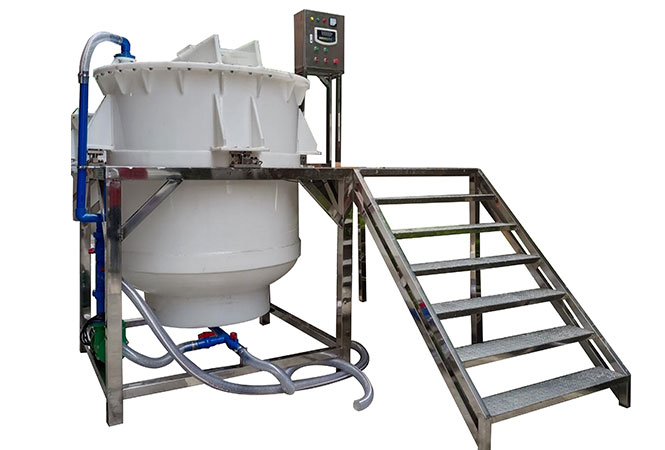
In cosmetic manufacturing, the vacuum homogenizing emulsifier has become fundamental equipment for producing high-quality products. From daily skincare lotions to professional salon products, nearly all cream-based cosmetics benefit from this technology.
High-End Skincare Production places the highest demands on emulsification technology. Products like anti-aging serums and repair creams require stable incorporation of active ingredients (such as vitamin C, hyaluronic acid, peptides) within emulsion systems while maintaining a lightweight feel and good transdermal absorption. A vacuum homogenizing emulsifier can prepare emulsions with extremely narrow particle size distributions (typically 100-500 nanometers). This ultra-fine structure not only provides a silky texture but also enhances the stability and bioavailability of active ingredients.
Innovation in Color Cosmetics also relies on vacuum homogenizing emulsifier technology. Products like foundations and primers require uniform pigment distribution, long-lasting wear, and a natural feel. Modern vacuum homogenizing emulsifiers can perfectly integrate powder and liquid bases, preventing clumping and sedimentation, while vacuum deaeration ensures a lightweight, non-greasy product texture.
In the pharmaceutical field, vacuum homogenizing emulsifier technology is transforming the production of drug delivery systems, playing a key role particularly in the development of novel formulations.
Production of Emulsion-Type Drugs imposes extremely high requirements on homogenization technology. Intravenous fat emulsions, lipid-soluble drug emulsions, etc., require strict control of particle size within safe ranges (typically less than 1 micron) to avoid risks like vascular embolism. Vacuum homogenizing emulsifiers, through precise control of shear parameters and vacuum levels, can prepare medical emulsions compliant with pharmacopoeial standards, with batch-to-batch variation less than 5%, significantly outperforming traditional methods.
Development of Novel Drug Delivery Systems such as nanoemulsions, microemulsions, and liposomes relies on high-precision emulsification technology. These advanced formulations can improve the bioavailability of poorly soluble drugs and enable targeted delivery and sustained release. By optimizing process parameters, a vacuum homogenizing emulsifier can prepare nanocarrier drug systems with specific particle sizes and surface properties without compromising drug activity.
When selecting a vacuum homogenizing emulsifier, multiple technical parameters must be comprehensively evaluated against actual production needs:
Processing Capacity and Batch Size are primary considerations. Small laboratory equipment typically handles 1-50 liters, suitable for R&D and small-batch trial production; pilot-scale equipment capacities range from 50-500 liters for process scale-up and clinical sample production; industrial production equipment capacities can reach 500-5000 liters, meeting large-scale production demands. Notably, scalability should be maintained between equipment of different sizes to ensure smooth translation of laboratory results into industrial products.
Shear Rate and Homogenization Effect directly impact the fineness and uniformity of the final product. High-end vacuum homogenizing emulsifiers can achieve shear rates of 20-40 meters/second, capable of preparing fine emulsions with particle sizes below 1 micron. Selection requires determining the necessary shear intensity based on product requirements, while considering whether the equipment offers multi-stage adjustable functions to accommodate materials of different viscosities.
The level of intelligence in modern vacuum homogenizing emulsifiers significantly impacts production efficiency and product consistency:
Programmable Control Systems allow operators to preset complete production processes, including temperature profiles, vacuum level changes, homogenization time and intensity, among other parameters. Excellent control systems should feature recipe storage capabilities, enabling one-touch retrieval of validated processes, reducing human error, and ensuring batch-to-batch consistency.
Data Logging and Traceability Systems are particularly important in GMP (Good Manufacturing Practice) environments. Equipment should completely record process parameters, environmental conditions, and operational records for each batch. This data is not only used for quality control but also serves as crucial evidence for regulatory audits.
Safety Interlock and Alarm Systems ensure the equipment automatically takes protective measures under abnormal conditions. For example, if temperature exceeds the set range or vacuum levels are abnormal, the system should automatically pause and alert operators, preventing batch loss and safety incidents.
With the deepening of Industry 4.0 concepts, vacuum homogenizing emulsifiers are evolving towards high levels of intelligence and networking:
Adaptive Control Systems can adjust process parameters in real-time based on online sensor data. For instance, by monitoring emulsion particle size with an online particle size analyzer, the system can automatically adjust shear rate or processing time to ensure product quality remains stable within the set range. This closed-loop control system significantly reduces dependence on operator experience while improving product consistency.
The Application of Digital Twin Technology allows simulation and optimization of the emulsification process in a virtual environment. Manufacturers can test the impact of different process parameters on the final product without affecting actual production, shortening new product development cycles and reducing trial-and-error costs.
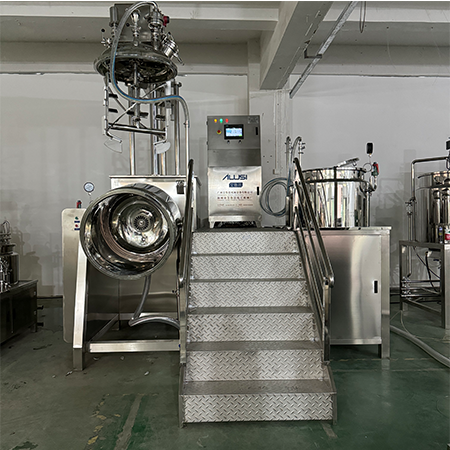
Environmental pressures and technological advancements are driving vacuum homogenizing emulsifiers towards greater efficiency and sustainability:
Energy Recovery Systems capture and reuse heat generated during equipment operation for preheating feed materials or other thermal needs within the plant. Advanced equipment can achieve energy recovery efficiencies exceeding 60%, significantly reducing overall energy consumption.
Innovations in Cleaning Technology reduce water and chemical consumption required for equipment cleaning. Self-cleaning systems, detachable designs, and optimized CIP (Clean-In-Place) systems can reduce cleaning time by 30-50% while improving cleaning effectiveness and lowering cross-contamination risks.
Modular Design extends equipment lifespan and enhances flexibility. Standardized interfaces and replaceable modules allow users to adapt equipment functionality according to product line changes, avoiding complete equipment obsolescence and aligning with circular economy principles.
Vacuum homogenizing emulsifier technology, as a critical link in modern manufacturing, is continuously breaking the limitations of traditional processes. From improving product quality to optimizing production efficiency, from ensuring batch consistency to driving new product innovation, the value of this technology is increasingly prominent across industries. As trends towards intelligentization and sustainability deepen, vacuum homogenizing emulsifiers will continue to evolve, providing more precise, efficient, and environmentally friendly mixing solutions for global manufacturing. For enterprises seeking product upgrades and process optimization, a deep understanding and application of this technology will undoubtedly provide a significant competitive advantage in fierce market competition.

Contact Us