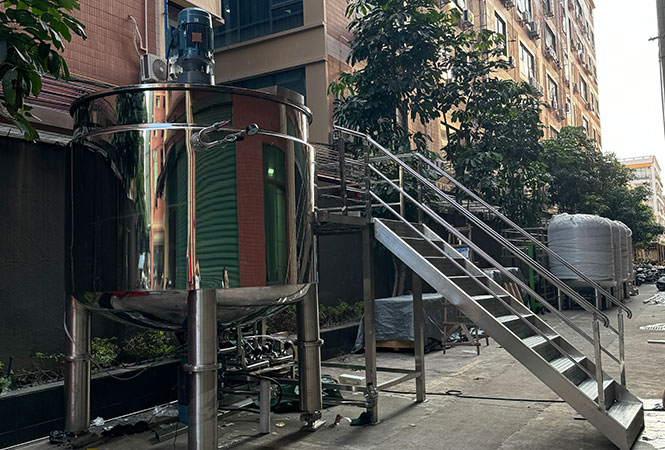
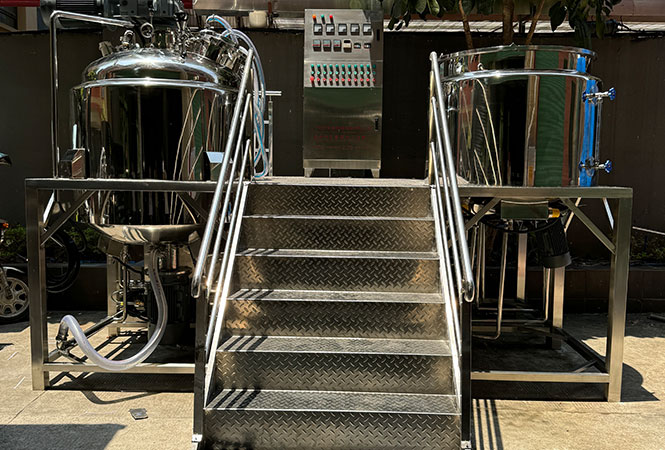
As a core production equipment in cosmetics, food, pharmaceuticals, fine chemicals and other sectors, the vacuum homogenizing emulsifier is key to achieving molecular-level integration of materials and ensuring product texture and stability. Compared with traditional atmospheric-pressure emulsification equipment, it boasts the core advantages of bubble control in a vacuum environment, high-speed homogenizing shearing, and multi-process integration. It fundamentally solves industry pain points such as product layer separation, air bubble residue, and active ingredient oxidation.
However, the current market is flooded with a wide range of equipment models with significant parameter differences. Enterprises are prone to fall into the traps of “prioritizing price over performance” and “insufficient matching degree” during selection. Meanwhile, improper parameter settings in actual operation often compromise emulsification results. This guide delves into the core technical advantages, industry adaptation essentials, scientific selection methods, and practical optimization tips of vacuum homogenizing emulsifiers. It deciphers the core value of the equipment through real production scenarios, providing actionable references for enterprises to select suitable equipment, improve production efficiency and product quality. Additionally, it clarifies common misconceptions in equipment usage.
Homogenizer Emulsion Machine
Core Technical Advantages: Why Vacuum Homogenizing Emulsifiers Outperform Traditional Equipment
The core competitiveness of vacuum homogenizing emulsifiers lies in combining a vacuum environment with a high-efficiency homogenizing system, upgrading the emulsification process in terms of physical field regulation and process efficiency. This is the essential difference from traditional atmospheric-pressure emulsifiers, with specific advantages reflected in five core dimensions.
Vacuum bubble control: Ensure product stability from the sourceThe equipment can achieve an adjustable vacuum degree ranging from -0.08 to -0.1 MPa, completing material mixing and emulsification in a sealed space to avoid air entrainment throughout the process. Meanwhile, dynamic degassing technology removes trace air bubbles in real time, completely eliminating defects such as pores and honeycomb-like air holes in finished products. More importantly, the vacuum environment can remove dissolved oxygen in materials, preventing oxidation and rancidity of active ingredients such as oils and vitamins. This effectively extends the shelf life of cosmetics and food products, and avoids process failures like material overflow during filling and shape deformation during baking, reducing the rejection rate.
High-efficiency homogenizing shearing: Realize molecular-level material integrationEquipped with a high-speed emulsifying head with variable frequency adjustable speed up to 0-6000 r/min, it generates strong shearing force, centrifugal force and cavitation effect. These forces shatter material particles to micron even nanometer scale, achieving molecular-level integration of water and oil phases.Cooperated with a 360° dead-angle-free wall-scraping stirring device, it not only prevents uneven concentration caused by material adhesion to the wall, but also further eliminates tiny air bubbles, resulting in a smooth and delicate product texture. It fundamentally solves the problems of uneven homogenization and grainy texture when traditional emulsifiers handle high-viscosity materials.
Reduce energy consumption and improve process conversion efficiencyThe vacuum environment slightly reduces liquid surface tension, making it easier for oil and water phases to be sheared and dispersed. To achieve the same emulsification effect, the required speed of the equipment is 30%~50% lower than that of atmospheric-pressure emulsifiers. This not only reduces energy consumption, but also decreases mechanical wear of the emulsifying head, extending the service life of the equipment. At the same time, the vacuum environment accelerates the adsorption of emulsifiers at the oil-water interface. A complete interfacial film that takes 15 minutes to form under atmospheric pressure can be completed in 8~10 minutes under vacuum, greatly shortening the production cycle. For example, the production time of 500 kg of custard sauce can be reduced from 2-3 hours to less than 30 minutes.
Multi-function integration: Adapt to diversified production needsThe equipment integrates heating, cooling, vacuum pumping, automatic stirring and other functions. It can precisely control process parameters according to material characteristics to meet the production requirements of different products. It also supports customized configurations, allowing adjustments to stirring head types, speed ranges, and homogenizer styles. Whether it is formula research and development for laboratory small-scale tests or large-scale industrial production, it can be flexibly adapted, covering the process needs of food, cosmetics, pharmaceuticals and other industries.
Hygienic design: Meet high-cleanliness production standardsParts in contact with materials are made of 304 or 316L food-grade stainless steel, treated with mirror polishing for easy cleaning without residue. It complies with GMP production standards, and the parts are easy to disassemble with self-cleaning function, effectively reducing the risk of cross-contamination during production. This is particularly important for industries with high cleanliness requirements such as pharmaceuticals and high-end cosmetics.
Industry Adaptation Scenarios: Precise Matching is the Key to Efficient Production
The versatility of the equipment enables its wide application in multiple industries. However, different industries have different material characteristics and product requirements, leading to differentiated demands for equipment configurations and parameters. Selecting the right adaptation plan is crucial to maximizing equipment value. The key adaptation points for core industries are as follows.
Cosmetics industry: Suitable for products such as creams, lotions, serums, and sunscreens. Focus on selecting equipment that can achieve nanoscale homogenization to ensure delicate and easily absorbable product texture. Meanwhile, the vacuum environment can protect heat-sensitive active ingredients such as plant extracts and hyaluronic acid from loss during production, improving product usability and efficacy stability. The equipment capacity is recommended to be selected according to production scale, ranging from 5L to 2000L. Small-capacity models are used for laboratory research and development, while modular large-capacity models are for mass production.
Food industry: Applicable to products like salad dressings, mayonnaise, ice cream slurry, and custard sauce. The core requirements are the equipment’s bubble control capability and homogenization uniformity, ensuring dense sauce without air bubbles, uniformly refined fat globules, and improved product taste. Attention should also be paid to the heating and cooling system of the equipment to meet the temperature process requirements of food materials and prevent material deterioration.
Pharmaceutical industry: Used in the production of ointments, creams, and injectable emulsions. The equipment must comply with GMP sterile design standards, with higher requirements for vacuum degree and homogenization precision. It is necessary to ensure uniform dispersion of pharmaceutical ingredients and narrow particle size distribution (D90≤5μm), avoiding the risk of vascular embolism caused by uneven particle size of injectable emulsions. Meanwhile, the cleaning and cross-contamination prevention capabilities of the equipment are core considerations.
Fine chemical industry: Adapt to various products such as emulsified oils, coatings, and adhesives. Focus on selecting models with strong high-viscosity material handling capabilities, paired with customized stirring heads to ensure uniform material dispersion. The vacuum environment can reduce solvent volatilization, lower environmental pollution during production, and meet environmental protection production requirements.
Vacuum Emulsification Machine
Scientific Selection Methods: Avoid 90% of Enterprise Purchasing Pitfalls
At present, the most common mistake enterprises make during selection is focusing only on equipment capacity and price while ignoring the matching degree between material characteristics and equipment parameters. This results in equipment that fails to meet production needs or even causes product quality problems. Scientific selection methods should follow the principle of “process demand first, performance parameter core, manufacturer strength as guarantee”, completed in three steps.
Clarify core process needs and lock in basic equipment parametersFirst, sort out the characteristics of the materials to be processed, including viscosity, particle size, solid-liquid ratio, and whether they contain heat-sensitive or corrosive components. These directly determine the equipment material, stirring method, and shearing force. Second, determine the equipment capacity according to production scale, and consider future capacity expansion, prioritizing modular and upgradable models. Finally, clarify emulsification requirements, such as whether nanoscale homogenization is needed, particle size distribution standards, and whether linkage control with batching tanks, filling machines and other equipment is required.
Evaluate core performance indicators and reject false parameter labelingFocus on three core performances: First, vacuum performance, pay attention to the airtightness of the vacuum pump and the adjustable range of vacuum degree. The equipment is required to quickly reach the target vacuum degree and maintain stability without air leakage. Second, homogenization effect, which can be verified through trial operation. The processed materials are required to have uniform particle size without particles, and consistent homogenization effect across different batches. Third, temperature control precision. For heat-sensitive materials, the equipment should have PID automatic adjustment function, stable heating and cooling rates, and temperature error controlled within ±1℃. At the same time, check whether the equipment operation interface is intuitive, whether it has fault alarm and data recording functions to facilitate production management and process traceability.
Assess comprehensive manufacturer strength to ensure subsequent user experienceChoosing equipment is not only about purchasing hardware, but also about selecting subsequent technical support and services. Prioritize manufacturers with independent R&D capabilities, whose product lines are more abundant and can provide customized solutions according to the enterprise’s special processes. Meanwhile, check whether the manufacturer has passed ISO9001 and other quality management system certifications, and whether the core components of the equipment are well-known brands to ensure the manufacturing precision and stability of the equipment. After-sales service is key. It is necessary to investigate the manufacturer’s after-sales service network and response speed, whether it provides on-site engineer training, 24-hour remote guidance, 48-hour on-site troubleshooting and other services to reduce downtime risks caused by equipment failures.
Practical Optimization Tips: Key Details to Improve Production Efficiency
After selecting the right equipment, scientific operation and parameter optimization can further exert equipment performance, avoiding poor emulsification effects caused by improper operation. The following practical details can effectively improve production efficiency and product quality.
Adjust homogenizing speed and vacuum degree according to material viscosity: When handling low-viscosity materials, appropriately reduce the homogenizing speed (2000-3000 r/min) and control the vacuum degree at -0.06~-0.08 MPa to balance efficiency and energy consumption. When processing high-viscosity materials such as creams and ointments, increase the homogenizing speed (4000-6000 r/min) and adjust the vacuum degree to -0.09~-0.1 MPa to ensure thorough air bubble removal and uniform material homogenization.
Optimize feeding sequence to improve emulsification efficiency: It is recommended to first heat the water-phase materials to the target temperature, then slowly add the oil-phase materials under vacuum, and finally add emulsifiers and active ingredients. This avoids problems such as uneven emulsifier dispersion and slow interfacial film formation caused by improper feeding sequence, and reduces the loss of active ingredients due to local overheating of materials.
Regularly maintain the homogenizing head and sealing system: The homogenizing head is a core wearing part of the equipment. It is necessary to regularly check the wear condition according to production frequency and replace it in a timely manner. The sealing ring of the vacuum sealing system should be regularly cleaned and replaced to prevent insufficient vacuum degree caused by poor sealing, which affects bubble control effect. Maintenance should follow the equipment operation specifications to ensure proper installation of components.
Clarify Misconceptions and Correctly View the Application Value of Vacuum Homogenizing Emulsifiers
In actual production, many enterprises have cognitive biases towards vacuum homogenizing emulsifiers, resulting in underutilization of equipment value. There are two major common misconceptions to clarify.
Misconception 1: Vacuum homogenizing emulsifiers are expensive, so small and medium-sized enterprises do not need to purchase themIn fact, although the one-time purchase cost of the equipment is 40%~60% higher than that of traditional emulsifiers, it can reduce post-processing procedures such as defoaming and filtration, lower rejection rates and labor rework costs, while improving product quality to enhance market competitiveness. In the long run, the comprehensive production cost is lower. At present, there are small-capacity, cost-effective models suitable for small and medium-sized enterprises to meet small-batch production needs.
Misconception 2: The higher the speed, the better the emulsification effectIn fact, the homogenization effect is the combined result of vacuum degree, speed and stirring method. Blindly increasing the speed not only increases energy consumption and equipment wear, but also may cause local overheating of materials and damage heat-sensitive components. The scientific approach is to match vacuum degree and speed according to material characteristics to achieve the optimal combination of process parameters.
High Shear Emulsifier Homogenizer
Conclusion
The vacuum homogenizing emulsifier is not a simple “equipment upgrade”, but a technological innovation in the emulsification process. By combining a vacuum environment with a high-efficiency homogenizing system, it fundamentally solves the problems of air bubbles, uneven homogenization and low efficiency in traditional emulsification processes, becoming an essential piece of equipment for high-end product production.
For enterprises, the core of selecting a vacuum homogenizing emulsifier is not to pursue “high parameters”, but to achieve precise matching between equipment and processes based on their own industry attributes, material characteristics and production scale. Meanwhile, through scientific operation and maintenance, the core value of the equipment can be fully exerted. In an era where product quality has become the core market competitiveness, selecting and using vacuum homogenizing emulsifiers correctly can not only improve production efficiency and reduce comprehensive costs, but also produce high-quality products with delicate texture and high stability, laying a solid foundation for the enterprise’s market development.
In addition, with the development of intelligent technology, the automation and customization level of vacuum homogenizing emulsifiers will continue to improve. Enterprises can also consider the upgradability of equipment when making selections to adapt to future production needs.