
Products
A vacuum mixer homogenizer is an advanced industrial equipment that combines three critical processes: mixing, homogenization, and degassing under vacuum conditions. Unlike traditional mixers, it operates in a sealed environment to eliminate air bubbles, ensuring uniform particle distribution and preventing oxidation. This technology is widely used in industries such as pharmaceuticals, cosmetics, food processing, and adhesives manufacturing where product consistency and quality are paramount.
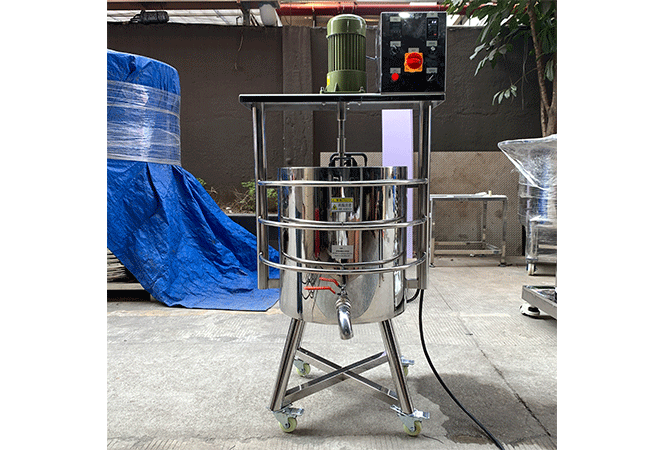
The main components include a vacuum chamber, high-shear homogenizer, mixing blades, temperature control system, and vacuum pump. The vacuum chamber maintains pressure levels as low as 0.01 MPa, while the homogenizer uses rotor-stator technology to reduce particle size to micrometer or nanometer scales. Mixing blades are designed for specific applications—anchor blades for viscous materials, propeller blades for liquid mixing—ensuring optimal material interaction.
Vacuum mixing eliminates air entrapment, which is a common issue in conventional mixing. Air bubbles can cause defects like surface imperfections, reduced shelf life, and inconsistent texture. By operating under vacuum, manufacturers achieve products with smooth surfaces, uniform viscosity, and improved stability. For example, in cosmetic creams, vacuum mixing prevents the formation of foam, resulting in a luxurious, non-porous texture that consumers prefer.
Vacuum mixer homogenizers reduce processing time by combining multiple steps into one operation. Traditional methods often require separate mixing, degassing, and homogenization stages, which are time-consuming and energy-intensive. With integrated systems, manufacturers can achieve desired results in 30-50% less time. Additionally, the precise control over mixing parameters minimizes material waste, leading to significant cost savings over time.
In pharmaceuticals, vacuum mixer homogenizers are used to produce ointments, creams, and suspensions. The vacuum environment ensures sterility and prevents contamination, which is critical for drug safety. For instance, in the production of topical antibiotics, the homogenizer reduces particle size to ensure uniform drug distribution, enhancing bioavailability. The degassing process also prevents oxidation of sensitive active ingredients, extending product shelf life.
Cosmetic manufacturers rely on vacuum mixer homogenizers to create high-quality products like lotions, serums, and foundations. The technology ensures that ingredients like oils, water, and active compounds are emulsified evenly, resulting in products with a smooth, non-greasy feel. Vacuum degassing eliminates air bubbles, which is essential for achieving a flawless finish in products like liquid foundations and eye creams. Brands like L’Oréal and Estée Lauder use this technology to maintain their reputation for premium quality.
When choosing a vacuum mixer homogenizer, key factors include capacity (ranging from 5L lab-scale to 1000L industrial models), homogenization speed (up to 15,000 RPM), vacuum level, and material compatibility. For example, stainless steel chambers are ideal for food and pharmaceutical applications due to their corrosion resistance and ease of cleaning. Manufacturers should also consider customization options—some models offer programmable controls, CIP (Clean-in-Place) systems, and explosion-proof designs for hazardous materials.
Leading manufacturers include IKA Works, Silverson Machines, and FrymaKoruma. IKA’s Magic Lab is a popular lab-scale model with interchangeable homogenizing heads, suitable for R&D applications. Silverson’s Verso Mixer offers scalable solutions from lab to production, while FrymaKoruma specializes in high-viscosity mixing for the cosmetics industry. When evaluating manufacturers, consider factors like after-sales support, warranty periods, and availability of spare parts.
Proper maintenance is crucial for extending the lifespan of vacuum mixer homogenizers. Daily tasks include cleaning the mixing chamber, checking vacuum pump oil levels, and inspecting seals for wear. Weekly maintenance involves lubricating moving parts and calibrating temperature sensors. Annual servicing should be performed by certified technicians to inspect the homogenizer’s rotor-stator assembly and replace worn components. Following these practices can prevent unexpected downtime and ensure consistent performance.
Common issues include loss of vacuum, uneven mixing, and overheating. Loss of vacuum often results from damaged seals or a faulty vacuum pump—inspect seals for cracks and replace if necessary. Uneven mixing may be due to incorrect blade speed or material viscosity; adjust the speed or use a different blade type. Overheating can be caused by prolonged operation without cooling—ensure the temperature control system is functioning correctly and allow the machine to cool between batches. Consulting the manufacturer’s manual for troubleshooting guides is always recommended.
The future of vacuum mixer homogenizers lies in Industry 4.0 integration. Smart models equipped with IoT sensors can monitor parameters like temperature, pressure, and mixing speed in real-time. Data is transmitted to cloud-based platforms for analysis, allowing manufacturers to optimize processes and predict maintenance needs. For example, predictive analytics can alert operators to potential seal failures before they occur, reducing downtime. This technology also enables remote monitoring, which is particularly useful for multi-site operations.
As environmental regulations become stricter, manufacturers are focusing on sustainable design. Modern vacuum mixer homogenizers feature energy-efficient motors, heat recovery systems, and reduced water consumption. For instance, some models use variable frequency drives (VFDs) to adjust motor speed based on load, reducing energy usage by up to 30%. Additionally, materials like carbon fiber are being used to reduce weight and improve durability, further enhancing sustainability. These trends not only benefit the environment but also reduce operational costs for manufacturers.
Vacuum mixer homogenizers are indispensable tools in modern manufacturing, offering unparalleled precision, efficiency, and product quality. By understanding their functionality, benefits, applications, and maintenance requirements, businesses can make informed decisions to optimize their production processes. As technology advances, integrating smart features and sustainable design will further enhance their value, making them a cornerstone of high-efficiency manufacturing for years to come.
For more information on vacuum mixer homogenizers, contact our experts today to find the perfect solution for your industry needs.

Contact Us